State-aware queues
Pending, uncoded, coded, warning, ready, excluded, and posted states communicate what can actually move.
Bank feed automation
LedgerHQ uses Plaid-connected bank and card activity, explicit queue states, rules, posting controls, and Tally assistance to help firms process daily activity without losing the path to the ledger.
Pending, uncoded, coded, warning, ready, excluded, and posted states communicate what can actually move.
Bank account cards, transaction activity, coding, posting, and register paths remain connected.
Bookkeepers and Tally can work from company queues while the firm retains broader visibility.
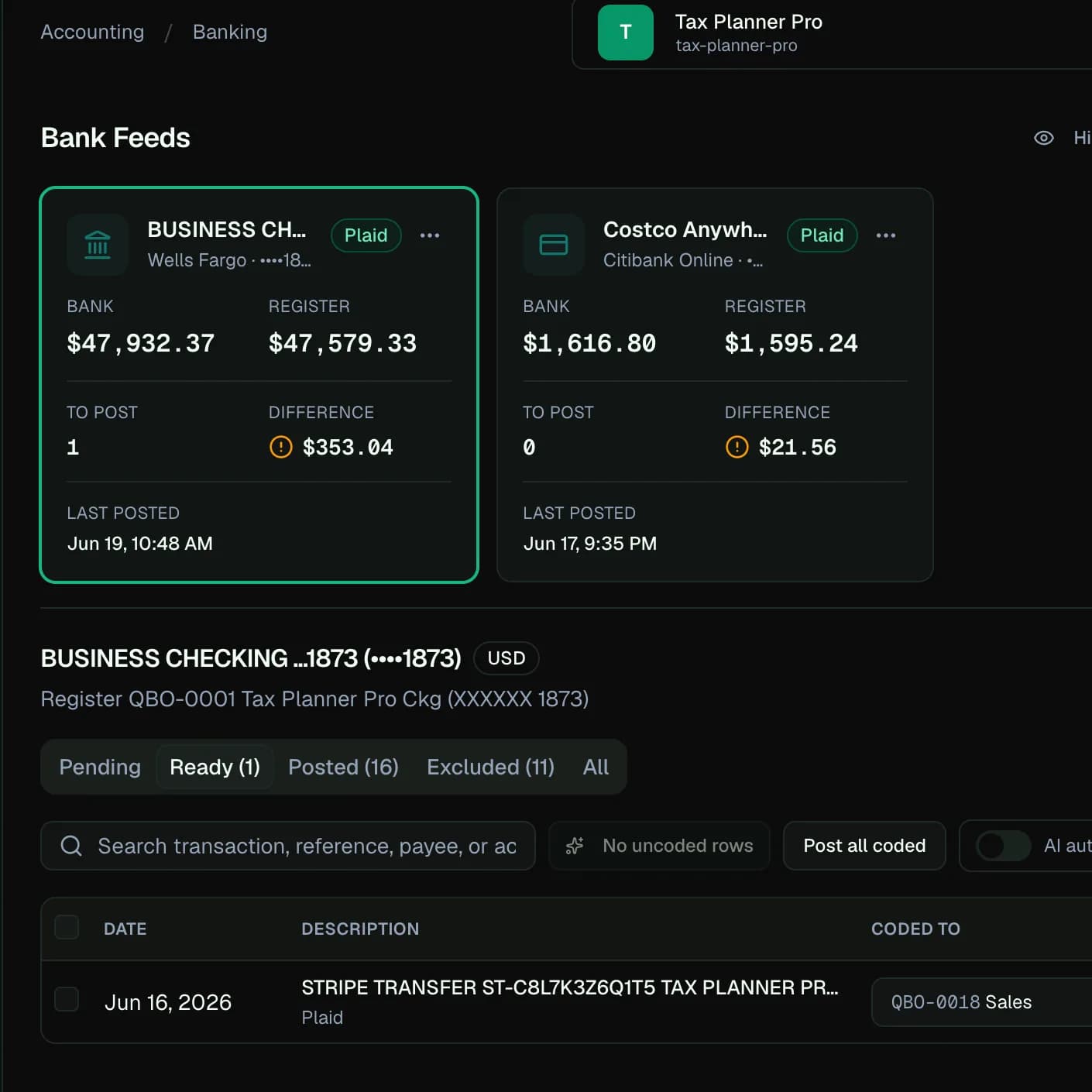
A bank feed provides transaction evidence, but the feed row is not automatically a complete ledger decision. Pending state, duplicate risk, transfer relationships, business purpose, and the correct account still matter.
LedgerHQ keeps the feed state visible and uses the supported posting workflow to produce accounting records.
The most useful automation separates clean repeat activity from rows that need research or human judgment. Rules, category suggestions, match workflows, exclusions, and posting controls each have a different purpose.
A firm should be able to count what is truly ready without inflating the queue with pending or already posted activity.
Once supported activity is posted, the register and journal evidence become the accounting source. Reconciliation then compares posted account activity with statement evidence.
That sequence prevents the bank feed from becoming a parallel ledger that looks clean while the actual books remain incomplete.
How the workflow moves
The exact action depends on permissions, company context, and the evidence available. The workflow stays inspectable from intake through review.
Only coded, eligible activity should move through posting, and warnings, period locks, company scope, role permissions, and reconciliation state remain enforceable.
Plaid is the supported bank activity source. LedgerHQ does not promise every institution, instant settlement, perfect merchant detail, or a generic provider-import marketplace.
Questions
LedgerHQ uses Plaid for supported bank and card activity.
Pending activity remains distinct and should not be described as ready-to-post or reconciliation-ready work.
Supported trusted rule workflows can prepare or move clean matching activity according to configuration and safeguards. Warnings and ineligible rows stay out of the clean path.