One firm, many companies
Move between company books without losing the firm-level view of outstanding bookkeeping work.
For accounting firms
Manage many company books from one firm workspace, keep the general ledger and daily workflow connected, and give staff and Tally a clear view of what needs attention next.
Move between company books without losing the firm-level view of outstanding bookkeeping work.
Charts, journals, registers, bank activity, reconciliations, and reports remain connected inside each company.
Use automation and Tally for repeat work while keeping exceptions, approvals, and resulting records visible.
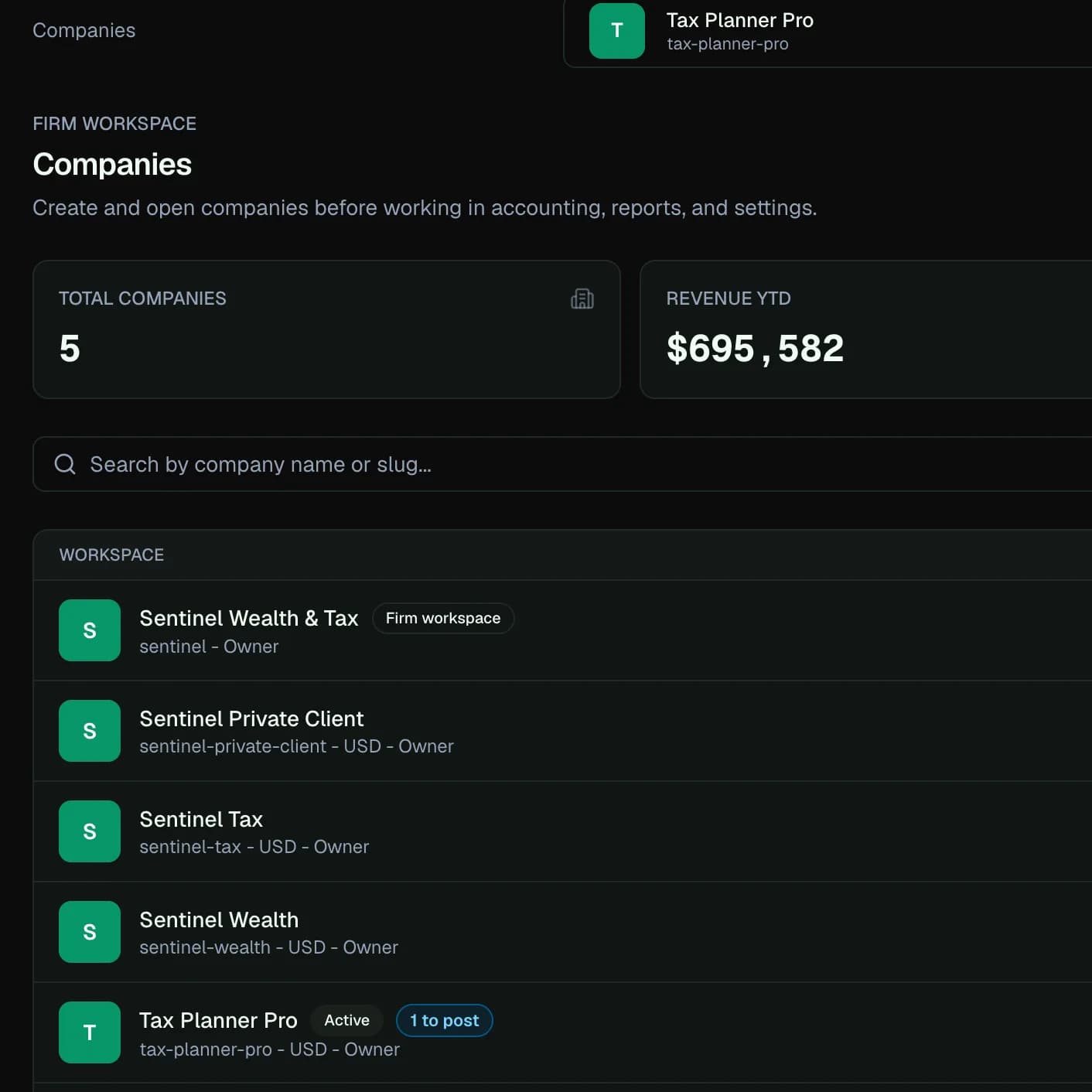
LedgerHQ treats the firm and each managed company as distinct scopes. The firm can see its accessible companies and move into the company workspace where that company's chart, entries, bank activity, reconciliations, reports, and requests live.
That structure matters for both speed and control. Staff should not have to rebuild context every time they switch companies, and a company-specific action should never quietly run against another company's books.
A bookkeeping firm does not only need a dashboard. It needs a path from the signal to the work: which company has uncoded activity, which account is ready to reconcile, which request is waiting, and which report can be delivered.
LedgerHQ and Tally are designed to keep those paths close together so a firm can supervise throughput without reducing every company to a vague health score.
Rules can handle trusted recurring patterns. Tally can help research, prepare, and perform supported work within configured authority. Staff can focus on transfers, unusual vendors, incomplete evidence, policy choices, and the review that actually needs accounting judgment.
The objective is not to hide who or what changed the books. It is to make routine work cheaper to identify and prepare while the firm keeps control of exceptions and completed output.
LedgerHQ is a strong fit for firms that perform after-the-fact bookkeeping across multiple companies and want a focused ledger, bank activity, reconciliation, reporting, request, API, and AI-agent surface.
It is not positioned as a broad ERP, payroll platform, inventory suite, CRM, project-management system, or tax-filing product. Firms that need those capabilities inside one application should evaluate that boundary before migrating.
How the workflow moves
The exact action depends on permissions, company context, and the evidence available. The workflow stays inspectable from intake through review.
Firm and company membership, roles, permissions, period locks, confirmations, and validated accounting services remain in force as work moves through LedgerHQ.
LedgerHQ is intentionally focused on firm-managed bookkeeping. It is not marketed as an all-in-one payroll, inventory, CRM, project, or tax-filing suite.
Questions
The primary design is a firm managing company books. Company owners can use supported portal and request experiences, but the bookkeeping workspace is firm-led.
LedgerHQ resolves firm membership, role permissions, and company access before protected workflows. Exact access depends on the staff role and firm configuration.
LedgerHQ supports reviewed QuickBooks financials imports from Chart of Accounts and Journal CSVs. Migration should be previewed and validated before any replacement operation.
LedgerHQ Core is the bookkeeping workspace. The LedgerHQ + Tally package adds the supervised AI bookkeeper and its supported firm workflow.
Keep exploring